|
Learning objectives
|
- To know the definition of the term "cell" as a main structural and functional unit of all the living things formation
- To compare the structure of a plant and an animal cells.
- To know the structure of organelles and their functions
- To respond and give opinions in English
|
|
Lesson objectives
|
All the students will be able to:
- Read the text in English, to learn the lesson material, to learn the main organelles of a cell
|
|
Most of the students will be able to:
- Name the common things and the differences in a cell structure of a plant and an animal cells.
|
|
Some of the students will be able to:
- Give characteristic to the main functions of a cell organelles
|
|
Values
|
High spirituality, secular society
|
|
Assessment Criteria
|
- Know the peculiarities of the structure of a plant and an animal cells
- Identify the common features in the cell structure of a plant and an animal cells.
- Compare the structure of a plant and an animal cells
- Make Venn diagram
- Make a model of a cell
|
|
Language objectives
|
Group work, interaction, cooperation, ability to listen and explain
|
|
Key words and phrases: organelles, ribosomes, nucleus, mitochondrion, a cell wall, cytoplasm, cytoplasmic membrane, plastids, cytoplasmic reticulum, lysosome, Golgi
body, Vacuole
|
|
Language style, writing in class:
|
|
Questions for the discussion:
|
|
What are all living things consist of?
|
|
Could you say, why?
|
|
Why is a cell called the main structural and functional unit of the structure of all living organisms?
|
|
Recommendations to writing: make a comparison table of animal and plant cells in notebooks
|
|
Previous study
|
Grade 7 the lesson material
|
|
Plan
|
|
Planned terms
|
Planned procedure
|
Resources
|
|
The beginning of the lesson
5 minutes
|
Teacher's greeting. Creating positive psychological atmosphere. Then all the students are divided into 4 groups. A picture "Plant Cell" stands for the first group. A
picture "Animal Cell" stands for the second group. A picture "Venn Diagram" stands for the third group. A picture "Cell Model" stands for the fourth group.
Good morning, dear children. Sit down, please.
|
|
|
2 minutes
|
At the beginning of our lesson I'd like you to look at the board, then turn to each other, smile and wish each other a good day.
Well done!
Now I want you to watch a small video
Video presentation about a cell life
So, what was this video about?
Who wants to add anything?
Let's formulate the topic of our lesson according to the video.
|
|
|
3 minutes
|
Formulating the topic and lesson objectives by the students
So, the topic is the structure of an animal and plant cells.
What do you think the aim of our lesson is?
Very well
So, the aim of the lesson is to compare the structure of a plant and animal cells.
The topic and lesson objectives are on the screen
Students are proposed to answer the question on the screen:
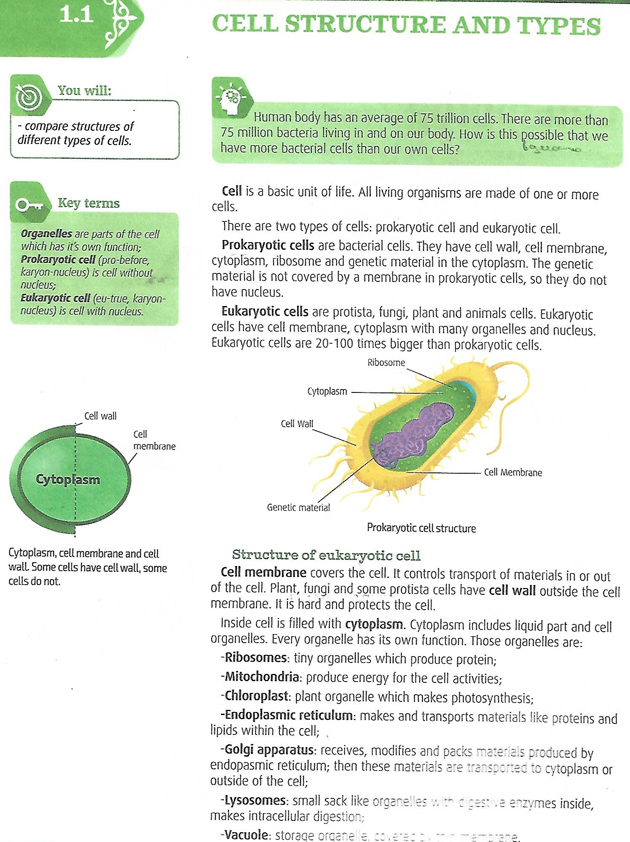
«Human body has about 75 trillion cells. There are more than 75 trillion bacteria living in and on our body. How is this possible that we have more bacterial cells than our own cells?»
Students respond.
|
|
|
The middle of the lesson
|
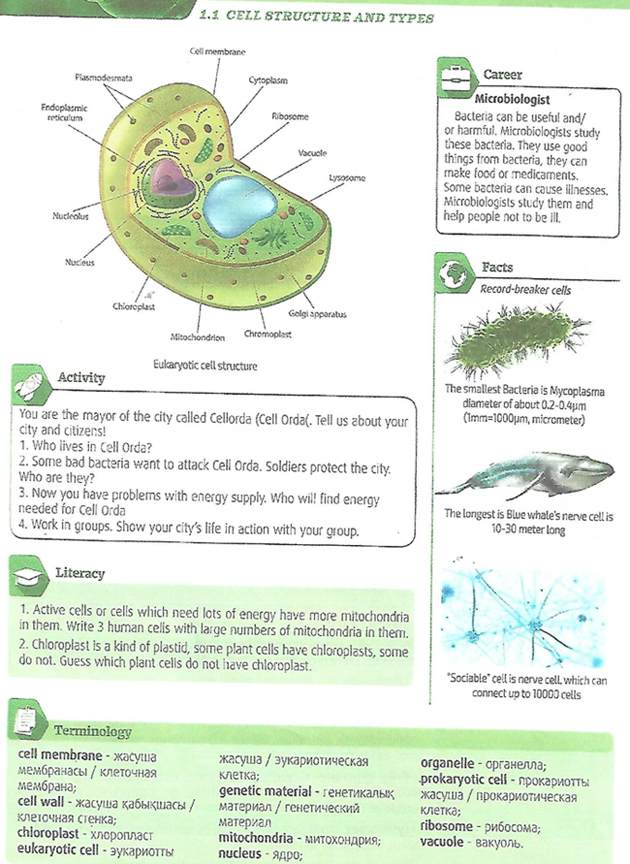
Let's learn some terms of cytology.
They are learning the terms, at the same time the organelles are shown in the presentation. The names of the organelles are called together by the teacher and the students.
Let's repeat them together
Excellent, very well
Now, you should read the text silently . 5 minutes for reading
|
|
|
10 minutes
|
Work with a textbook
The text in English is learnt by the students themselves. After reading they give their opinions on the content.
Give me some interesting facts from the text
The students give some interesting facts from the textbook on the cell structure
|
Biology Student's Book for the 8th grade in English
|
|
3 minutes
|
The students are proposed to watch a video on a cell structure and its organelles in English without captions.
Let's watch a video about a cell.
After watching the video the students give their opinions about that they have learned from it. They are supposed to fill in the sheets with cytology terms in English and Russian.
|
Меtodical instructions for the 8th grade
|
|
2 minutes
|
Now, fill in the table and translate the terms into Russian
Let's check up some terms. Show your work to the partner.
It's supposed to do peer checking-up. They correct mistakes if there are any.
|
Electronic software for Biology Student's Book for the 8th grade
|
|
6 minutes
|
Group work:
Now you have some worksheets. The task is for 4 groups.
The first group will make up a model of a plant cell.
The second group will make up a model of an animal cell.
The third group compare an animal and plant cells. They fill in Venn diagram with similar
and different organelles. Then they name only similar parts.
The fourth group makes up 5 true or false sentences in English on the topic and makes a model of the cell
Possible answers:
1. The plant cell has chloroplasts. - True
2. The animal cell has many chloroplasts - False
3. Cell membrane is around the cell - True
4. Vacuole is a big nucleus - False
5. The plant cell has 3 groups of plastids - True
|
Hair gel
Plasticine
Sheets of paper
Pictures of organellesF, their captions and functions in English
|
|
5 minutes
|
Presentation of the projects in front of the class:
The first two groups are making a model of a cell on a sheet of paper gluing the organelles, their captions and functions. The third group is making Venn diagram. The fourth group,
besides denoting True/False statements, is making a model of a cell in a glass using hair gel and colored plasticine for organelles. As far as presentations of different groups go, the
rest of the students can add something or correct mistakes if there are any.
Applause to each group of presenters.
Descriptors: the students…
- can retell the study material, can name the organelles and their functions in the pictures;
- match the text and appropriate picture;
- differ the organelles from each other and fine them in the picture.
|
|
|
1 minute
|
PE Break «Chromosomes' dance»: The students imitate and repeat the movements from the video
I want you to come to the blackboard and repeat the movements that you can see on the screen.
Now we are going to play a game. Please, divide in 2 groups (Here are the first and the second groups, and here are the third and the fourth groups) . Each student takes a card and name
the term. If you have a word "Skip" , then you give your card to the second group. If you have the word "BAM", then you give all you cards to the second group. The group that gets more
cards is the winner.
During the game the students quickly come up and take pictures and captions and translate them into Russian or English.
|
|
|
The end of the lesson
3 minutes
|
Name the terms from today's lesson.
Did we reach the aim of the lesson?
Write down your hometask. Repeat cell organelles and their functions, by learning the song that you will hear now.
На экране идет увлекательное видео о строении клетки на английском языке. Учащиеся могут повторять движения органоидов.
So, children. The lesson is over. You worked very well. Let's applaud to each other. Thanks to everyone.
Write your feedback in the stickers. What did you remember most from the lesson? Attach your feedbacks on the board.
Thanks
Feedback -is presented on the board
What new have I learnt at the lesson?
What was attractive at the lesson?
What should I think over?
What questions aren't clear so far?
They attach stickers on the board and applauder to each other.
|
|
Differentiation
How are you planning to support the students?
|
Assessment
How are you planning to evaluate the students' gained knowledge?
Formative assessment. Filled answer sheets are monitored by the teacher while doing the task. Correction is done if needed.
|
Subject relations
ICT-competence School Hygiene
Keeping Values
|
|
Conclusion
Denote two successful ways (in teaching, learning)
Applying of various teaching and learning strategies as well as approbation of learning strategies such as group work, dialogue studying and peer assessment
Individual, pair work and group work.
What ways can help you to improve your teaching?
Improve and vary the tasks after analysis students' doing them in class.
The tasks remained undone should be revised and transformed in a way. Some tasks weren't done because of lack of time.
What should be done to improve the upcoming lessons and to individualize teaching and learning process?
There is a necessity of making tasks according to individual and age peculiarities of students.
|