
"Методическая разработка урока английского языка в 9 классе УМК В.П. Кузовлев, Н.М. Лапа, Э.Ш. Перегудова "В мире музыки"
Цели и задачи урока :
Образовательные:
- Сформировать навыки употребления лексических единиц в диалогических высказываниях с опорой на вопросы;
- Проконтролировать знания лексического материала (прилагательные, положительно и отрицательно характеризующие музыку, виды музыки, чувства, которые появляются при прослушивании отрывков различных музыкальных стилей);
- Совершенствовать коммуникативную компетенцию учащихся на основе навыков владения лексическим материалом по теме.
Развивающая:
- Создать условия для развития навыка чтения с детальным пониманием;
- Развитие умения распределять внимание между использованием грамматических форм и содержанием;
- Создать условия для развития устной (диалогической и монологической) речи учащихся с использованием подстановочных упражнений;
- Развитие уважительного отношения к мнению собеседника.
Обучающая:
- Расширение знаний учащихся о музыкальных стилях.
Воспитательная:
- Воспитание эстетического вкуса учащихся путём прослушивания отрывков из различных музыкальных произведений;
- Развитие умения самостоятельного получения знаний, используя справочную литературу;
- Воспитания чувства прекрасного и возвышенного, необходимости в музыке, разъясняя роль и важность музыки в формировании личностных качеств.
Оборудование: компьютер, мультимедийный проектор, колонки, экран, учебник, лексико-культурологический справочник.
Ход урока
I. Организационный момент.
а) Приветствие :
Teacher:Good morning!
Pupils: Morning!
б) Сообщение плана урока:
Teacher: I`m very glad to sea you. Today we have with you some guests. You are welcome to the world of music. At the lesson we are to practi сe the words on our topic, to make up dialogues, to describe your feelings, to match the musical terms and definitions, to read and to translate the text.
II. Речевая зарядка.
Teacher: What is music?
Pupil1: I think it`s not the combination of pleasant sounds only.
Pupil2: It`s the art that reflects with its ideas and emotions.
Pupil3: By means of music you can express and feel anger and joy, suffering and happiness.
Teacher: You see music has a great power.
Answer the questions: What music do you like listening to when you have free time?
Pupil1: The music I love is sentimental.
Pupil2: Being free I listen to torchy music.
Pupil3: It depends on my mood. When I am free I listen to appealing music. (powerful, martial, sacred, spiritual, romantic, catchy, amazing, eloquent, fascinating, passionate,
torchy, unforgettable, breathtaking, sensational).
Teacher: What music irritates you?
Pupil1: The music I hate is complex.
Pupil2: I switch off the radio when I listen to cluttered music.
Pupil3: I think music makes us unhappy. (melancholy, overwhelming, cluttered, complicated, tuneless, dreadful, appalling, annoying, sacrilegious).
Teacher: What sort of music do you like?
Pupil1: My favourite music is pop music,
Pupil2: I enjoy rock music.
Pupil3: I adore folk music.
Pupil4: My joy is classical (country, dance, martial, sacred, organ, spiritual, jazz)music.
Teacher: I see. You are fond of different kinds of music. Tastes differ.
(Для выполнения данного упражнения можно использовать слова и словосочетания упражнения 1.3, страница 40).
III. Составление диалогов (развитие диалогической речи).
Teacher: As usual, young people are music-lovers. You and your partner are to speak about the power of music, to discuss the role of music in our life.
(В диалогах звучат вопросы What sort of music do you like? What does music make you think of? How can music influence people? What music do you like listening to when you have free time? What music irritates you?)
Pupil1: What sort of music do you like?
Pupil2: My favourite music is classical.
Pupil1: What does music make you think of?
Pupil2: When I listen to classical music it makes me think of different seasons.
Pupil1: How can music influence you?
Pupil2: Music can conquer my feelings.
Pupil1: What music do you like listening when you have free time?
Pupil2: When I am free I listen to sentimental music.
Pupil1: What music irritates you?
Pupil2: The music I hate is cluttered. I switch off radio when I listen to foolish music. I think music makes us funny .
IV. Развитие монологической речи учащихся.
Teacher: Music makes us think of people and places we love. It can evoke long forgotten events and feelings we thought we forgot.
What feelings does this music arouse in you? Listen to some tunes, match the tunes with the pictures, describe your feelings.
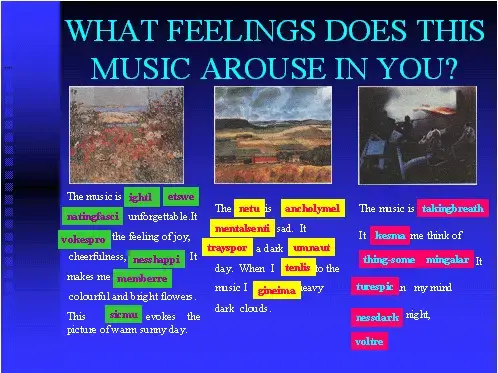
| The music is light, sweet, | The tune is melancholy, | The music is breathtaking |
| fascinating, unforgettable.It | sentimental, sad. It | It It makes me think of |
| provokes the feeling of joy, | portrays a dark autumn | something alarming. |
| cheerfulness, happiness. | day. When I listen to the | It pictures in my mind |
| makes me remember | music I imagine heavy | darkness, night, revolt. |
| colourful and bright flowers. | dark clouds. | |
| This music evokes the picture | ||
| of a warm sunny day. |
(Это упражнение можно предложить учащимся выполнять в группах, давая им возможность выразить чувства возникающие при прослушивании мелодий).
V. Физминутка.
Teacher: Are you tiered? Let`s have a break. Do exercises for your eyes.
Look to the left, look to the right, look down, look up, look around.
Look to the left, look to the right, look down, look up, look around.
Look to the left, look to the right, look down, look up, look around.
VI. Чтение тематического текста.
Teacher: The world of music is rich and varied, isn`t it?
Pupil1: Yes, it is. There are different genres and styles in music such as classical music that appeals to both our senses and intellect.
Pupil2: Folk music that reflects the history, customs and traditions of the country.
Pupil3: Dance music and pop music that are new rhythms probably as a result of changing times and so on.
Teacher: Match the musical terms and definitions.
- jazz;
- country music;
- rock`n`roll;
- blues;
- rap.
a) an American style of music based on variation. Since its beginning in the black community of New Orleans, Louisiana, USA around the turn of the century, it has continuously been involved into
many different styles. The constant elements are improvisation and variation.
b) music that is popular in and originated from the southern and western United States. It has many sources: traditional ballads, cowboy songs, Mexican music and the like.
c) a style of music that was popular especially in the 1950s but is still played now. It has a strong, loud beat and is usually played on electrical instruments.
d) a type of music that has its origins in America`s black community. Most songs are about loneliness, sadness or lost love, sometimes the words express a humorous reaction to life`s troubles.
e) a musical style where the singer speaks or shouts the words.
(Учащиеся прослушивают отрывки из музыкальных произведений относящиеся к предложенным музыкальным стилям, угадывают их и затем читают их словесное описание и переводят на русский язык).
Pupil1: I think the first tune is jazz.
Pupil2: In my opinion the second tune is country music.
Pupil3: It seems to me the third tune is rock`n`roll.
Pupil4: I am sure the fourth tune is blues.
Pupil5: I consider the fifth tune is rap.
VII. Проверка домашнего задания.
Teacher: Different composers from different countries have conquered the hearts and feelings of people all over the world.
(Проверка домашнего задания, можно использовать лексико-культурологический справочник с. 201).
Agree or disagree with me:
Teacher: Edvard Grieg was an American composer.
Pupil1: I disagree with you. He was a Norwegian composer.
Teacher: Gioacchino Rossini was an outstanding Russian composer.
Pupil2: I disagree with you. He was an Italian musician.
Teacher: Frederic Chopin was an English composer.
Pupil3: I disagree with you. He was a Polish composer.
Teacher: Ludwig van Beethoven was a famous German composer.
Pupil4: I agree with you. He was a German composer.
Teacher: Perter Ilyich Tchaikovsky was a great American composer.
Pupil5: I disagree with you. He was a great Russian composer.
Teacher: Claude Debussy was a popular Russian composer.
Pupil6: I disagree with you. He was a popular French composer.
Teacher: Felix Mendelssohn was a brilliant Czech composer.
Pupil7: I disagree with you. He was a German composer.
Teacher: Franz Schubert was a brilliant Russian writer of music.
Pupil8: I disagree with you. He was a brilliant Austrian writer of music.
Teacher: Antonio Vivaldi was an outstanding Italian composer.
Pupil9: I agree with you. He was n outstanding Italian composer.
Teacher: George Gershwin was an Italian composer.
Pupil10: I disagree with you. He was an American composer.
Teacher: Johann Sebastian Bach was a world famous English musician and composer.
Pupil11: I disagree with you. He was a world famous German musician and composer.
Teacher: Bela Bartok was a Hungarian composer.
Pupil12: I agree with you. He was a Hungarian composer.
Teacher: Antonin Dvor ak was a Russian composer.
Pupil13: I disagree with you. He was a Czech composer.
Teacher: Wolfgang Amadeus Mozart was an English composer.
Pupil14: I disagree with you. He was an Austrian composer.
Teacher: Igor Fedorovich Stravinsky was a wonderful German composer.
Pupil15: I disagree with you. He was a wonderful Russian composer.
VIII. Рефлексия.
Teacher: Did you like the lesson?
Pupil1: Yes, I did. /No, I didn`t. I didn`t like/ liked to make up dialogues.
Pupil2: Yes, I did. /No, I didn`t. I didn`t like/ liked to decode the adjectives.
Pupil3: Yes, I did. /No, I didn`t. I didn`t like/ liked to guess the music style.
Pupil4: Yes, I did. /No, I didn`t I didn`t like/ liked to listen to the tunes.
Pupil5: Yes, I did. /No, I didn`t. I didn`t like/ liked to speak about famous composers.
Pupil6: Yes, I did. /No, I didn`t. I didn`t like/ liked to put the verb in the right form.
IX. Подведение итогов урока.
Teacher: You were great today!
Учитель выставляет оценки и комментирует их.
X. Домашнее задание.
Teacher: Your home task is to prepare the story about your favourite style of music.