

Пасха в англоязычных странах "Easter"
Easter
Easter is a time of springtime festivals. In Christian countries Easter is celebrated as the religious holiday commemorating the resurrection of Jesus Christ, the son of God. But the celebrations
of Easter have many customs and legends that are pagan in origin and have nothing to do with Christianity.
Easter is a movable feast; that is, it is not always held on the same date. Easter is the first Sunday after the full moon after the moon's Spring Equinox.
The English name "Easter" is rather new. When the early English Christians wanted others to accept Christianity, they decided to use the name Easter for this holiday so that it would match the name
of the old spring celebration. It was derived from the name Eostre, the Anglo-Saxon goddess of spring. This made it more comfortable for other people to accept Christianity.
Easter symbols
 Eggs symbolize new life. Eggs have been a symbol of spring since ancient times. The egg is also a symbol of the rock
tomb of which Christ emerged when he rose again. Eggs are usually brightly painted to reflect the sunlight in spring.
Eggs symbolize new life. Eggs have been a symbol of spring since ancient times. The egg is also a symbol of the rock
tomb of which Christ emerged when he rose again. Eggs are usually brightly painted to reflect the sunlight in spring.
 The chick, hatching out of the egg, symbolizes new life and rebirth.
 The rabbit or Easter Bunny as it is known in America was a symbol of abundant life in ancient
times, and reminds us of spring and new life.
The rabbit or Easter Bunny as it is known in America was a symbol of abundant life in ancient
times, and reminds us of spring and new life.
 The white lilies symbolize the purity of Jesus. Lilies' emerging from the earth in spring also symbolize new life and
resurrection of Christ.
The white lilies symbolize the purity of Jesus. Lilies' emerging from the earth in spring also symbolize new life and
resurrection of Christ.
 The cross symbolizes Jesus' victory over death.
 Easter candles symbolize Jesus, "the light of the world".
 The butterfly with its life cycle symbolizes the life of Jesus Christ. The first stage is the caterpillar, which
stands for His life on Earth. The second phase begins from the cocoon stage, the crucifixion and burial of Jesus. The third and final stage is the butterfly, representing His raising from the
dead.
The butterfly with its life cycle symbolizes the life of Jesus Christ. The first stage is the caterpillar, which
stands for His life on Earth. The second phase begins from the cocoon stage, the crucifixion and burial of Jesus. The third and final stage is the butterfly, representing His raising from the
dead.
 Baby animals born in spring also represent spring and new life.
 Palm branches represent when Jesus arrived in Jerusalem on the first Palm Sunday and people waved palm branches,
welcoming him.
Palm branches represent when Jesus arrived in Jerusalem on the first Palm Sunday and people waved palm branches,
welcoming him.
Easter customs
 Easter Sunrise is celebrated because Mary Magdalene entered the garden and met Christ "at the rising of the sun".
People gather to pray when the sun appears and then in procession go to the church.
Easter Sunrise is celebrated because Mary Magdalene entered the garden and met Christ "at the rising of the sun".
People gather to pray when the sun appears and then in procession go to the church.
 Easter hats (bonnets) and wearing new clothes for Easter symbolizes new life offered through the death and
resurrection of Jesus.
Easter hats (bonnets) and wearing new clothes for Easter symbolizes new life offered through the death and
resurrection of Jesus.
 According to the legend, the tradition of the egg hunt was born in Germany where a white hare spends Easter Eve
hiding eggs which children can find the next day.
According to the legend, the tradition of the egg hunt was born in Germany where a white hare spends Easter Eve
hiding eggs which children can find the next day.
 One of the Easter traditions is eating Hot Cross Buns. These buns have a cross of icing on the top to remind people
of Christ.
One of the Easter traditions is eating Hot Cross Buns. These buns have a cross of icing on the top to remind people
of Christ.
 Egg rolling symbolizes the stone which rolled away from the tomb where Jesus was laid.
Egg-rolling is a traditional Easter pastime which is still popular in Britain. It takes place on Easter Sunday or Monday, and consists of rolling coloured, hard-boiled eggs down a slope until they
are cracked and broken after which they are eaten by their owners.
Egg rolling symbolizes the stone which rolled away from the tomb where Jesus was laid.
Egg-rolling is a traditional Easter pastime which is still popular in Britain. It takes place on Easter Sunday or Monday, and consists of rolling coloured, hard-boiled eggs down a slope until they
are cracked and broken after which they are eaten by their owners.
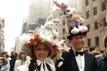 One of the best known Easter customs, which has a long history, is Easter parade or Easter
Bonnet parade as they called it in Great Britain. This custom is originated with the tradition of buying new clothes for Easter which people wore to church. After church services everyone went for a
walk around the town. The most famous parades are along Fifth Avenue in New York and in Battersea Park in London.
One of the best known Easter customs, which has a long history, is Easter parade or Easter
Bonnet parade as they called it in Great Britain. This custom is originated with the tradition of buying new clothes for Easter which people wore to church. After church services everyone went for a
walk around the town. The most famous parades are along Fifth Avenue in New York and in Battersea Park in London.
Easter Legend
Long, long ago there lived an old, woman who loved children very much. Each year she gave children presents to celebrate spring. One year she had nothing to give because the harvest was very poor. All she had were some eggs. She did not want to disappoint the children. So quickly before they came for their presents she coloured the eggs and hid them in the grass. When the children came she said to them: "Run out into the lawn and find your presents hiding there" The children began to look for the presents. At last they found a basket of coloured eggs under the bush. Suddenly a hare jumped out from under the bush. And the children decided that it was he, who had brought them the presents.
